
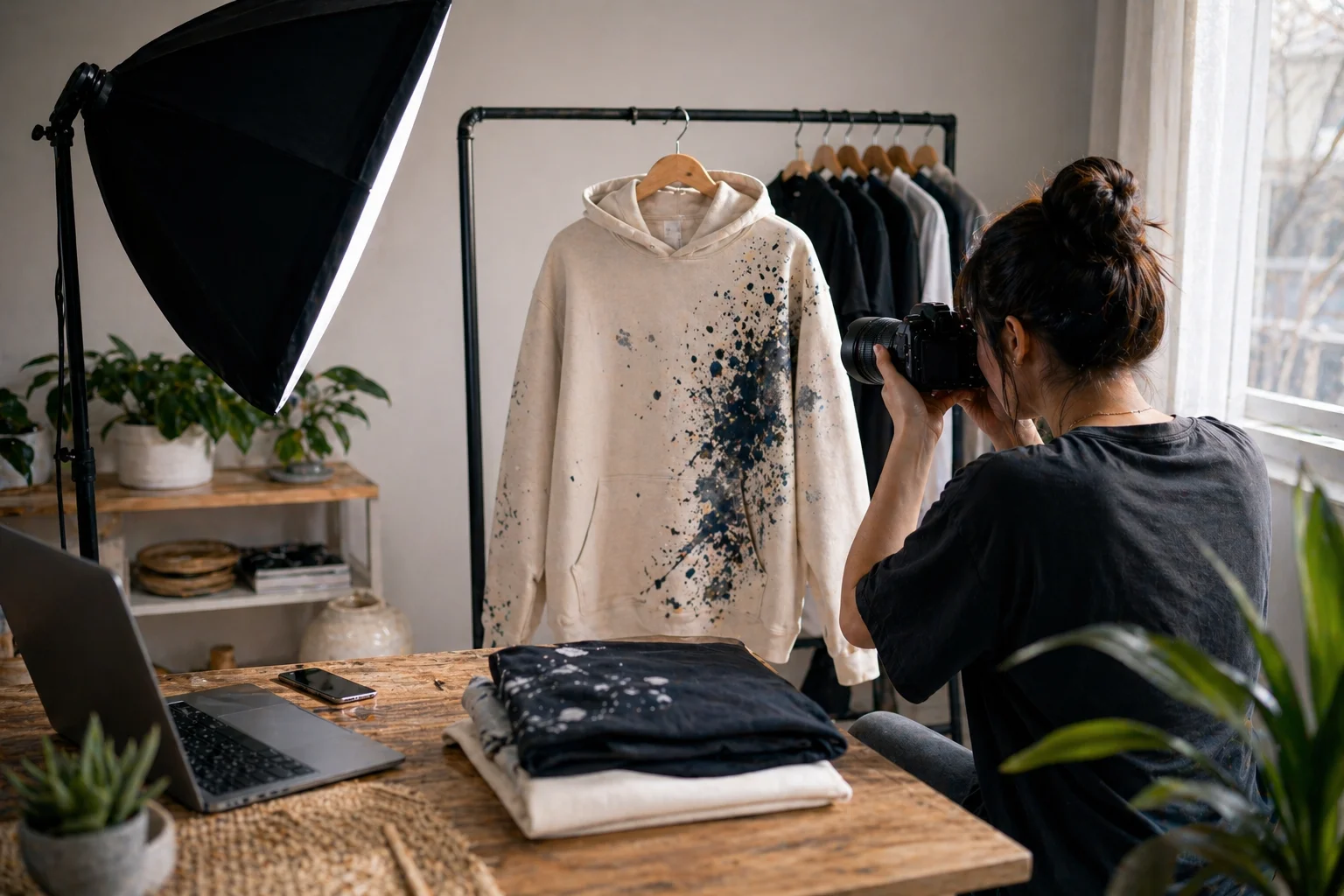
Product photography is one of the most influential factors in online clothing sales, yet many small fashion entrepreneurs underestimate how much it impacts customer decisions. A custom clothing business may produce exceptional hand-painted denim jackets, premium embroidered hoodies, personalized t-shirts, altered vintage pieces, or luxury handmade streetwear, but poor photography can make those products appear low quality. In e-commerce, customers cannot physically touch your garments, inspect stitching details, feel fabric softness, or try clothing on before purchasing. Your photos become the closest replacement for an in-person shopping experience.
This challenge becomes even more important for handmade clothing brands because customers are often paying premium prices. When someone spends significantly more on a customized product than they would on mass-produced retail clothing, they expect visual proof that your product deserves that premium price. Blurry images, inconsistent lighting, cluttered backgrounds, inaccurate colors, and weak styling can immediately reduce trust.
Meanwhile, brands with average products sometimes outperform better competitors simply because their photography feels polished and professional. Consumers often associate visual presentation with product quality, even when that assumption is not always accurate.
The good news is that professional product photography no longer requires renting expensive studios or purchasing thousands of dollars in equipment. Many successful clothing businesses create exceptional product images from apartments, garages, spare bedrooms, basements, and home offices. Smartphones now offer advanced camera quality, and affordable lighting tools make strong photography far more accessible than in previous years.
However, professional-looking product photography still requires planning. Lighting, composition, styling, editing, consistency, and platform-specific optimization all play major roles in how customers perceive your products.
Strong photography does far more than make clothing look attractive. It increases conversion rates, improves social media engagement, reduces returns, strengthens brand identity, and helps small businesses compete with far larger retailers.
Understand what customers need before they purchase
Many beginners make the mistake of focusing entirely on artistic photography while forgetting practical customer concerns.
Creative photography is valuable, but customers also need clear information before spending money.
A buyer may want to know how thick your hoodie material feels, how detailed your embroidery work is, how vibrant your hand-painted designs appear in natural lighting, or how oversized a t-shirt actually fits.
Your product photos should answer these questions before customers need to ask them.
For example, if you sell distressed denim jackets, close-up photos should clearly show distressing details.
If you create luxury embroidered hoodies, customers need close-up images that highlight stitching quality.
If your clothing uses premium materials, your photography should emphasize fabric quality.
Think from the customer’s perspective.
Every photo should reduce uncertainty.
Natural lighting remains one of the best tools
Many beginners assume professional photography requires expensive lighting setups.
Natural light often creates excellent results.
Large windows provide soft lighting that works extremely well for clothing photography.
Morning light and late afternoon light are often ideal because they tend to create softer shadows.
Direct midday sunlight may create harsh shadows and overexposed images.
White curtains can soften strong light.
Reflectors can help bounce light onto darker areas.
Many successful small clothing brands still rely heavily on window lighting because it creates natural color accuracy.
Natural lighting also helps reduce startup costs.
Artificial lighting creates consistency
Natural light can be inconsistent.
Weather conditions change quickly.
Canadian winters often reduce daylight availability, especially in cities such as Toronto, Montreal, and Vancouver.
This can make consistent photography difficult.
Affordable softbox lights provide more control.
Ring lights can help with smaller product shoots.
Continuous lighting systems become valuable as product volume increases.
Consistency across product listings creates stronger brand credibility.
Choose backgrounds intentionally
Background selection strongly affects product perception.
White backgrounds remain popular for e-commerce websites because they keep attention focused entirely on the product.
Marketplaces like Etsy often perform well with clean backgrounds.
Lifestyle backgrounds can also be highly effective when aligned with your brand.
Streetwear brands may benefit from urban settings.
Minimalist brands may prefer clean neutral environments.
Vintage brands may use thrift-inspired styling.
The background should support your brand identity without distracting from your clothing.
Flat lays create clean product control
Flat lay photography remains popular because it gives sellers complete control over composition.
Shirts, hoodies, hats, tote bags, and accessories often photograph well in flat lays.
This method works especially well for marketplaces like Shopify product pages.
Props should remain minimal.
The focus should stay on the clothing.
Wrinkles should always be removed before shooting.
Flat lays are often easier for beginners than model photography.
Model photography improves conversions
Customers often want to see how clothing fits on real people.
Model photography helps buyers visualize sizing, proportions, and styling possibilities.
Hiring professional models is not always necessary.
Friends, family members, or even self-modeling can work well.
Authentic photos often perform strongly on Instagram and TikTok.
Real-world visuals create stronger emotional connection.
They also help customers imagine ownership.
Capture detail shots
Many sellers fail to photograph important details.
Close-up shots can dramatically improve trust.
Photograph embroidery details.
Show fabric texture.
Capture buttons, zippers, labels, stitching, and custom artwork.
These details communicate craftsmanship.
Premium pricing becomes easier to justify when quality is visible.
Detailed photos often reduce customer hesitation.
Editing should improve consistency, not create deception
Editing software helps improve professionalism.
Adobe Photoshop, Adobe Lightroom, and Snapseed are commonly used tools.
Adjust brightness, crop images properly, and improve consistency.
Avoid changing product colors dramatically.
Misleading edits often increase returns and negative reviews.
Customers expect accuracy.
Lifestyle photography strengthens brand storytelling
Lifestyle photography creates emotional appeal.
Show your products in environments that match your target audience.
Streetwear may perform well in urban locations.
Luxury handmade products may fit premium indoor environments.
Outdoor photography may support adventure-inspired brands.
Lifestyle content works especially well for social media marketing.
It helps customers imagine your clothing in their own lives.
Photograph packaging for premium perception
Packaging photography can improve perceived value.
Show branded packaging.
Display thank-you cards.
Highlight gift-ready presentation.
This works especially well for premium and gift-focused products.
Professional packaging reinforces trust.
Build a repeatable workflow
As your business grows, photography can become time-consuming.
Create efficient systems.
Batch product shoots.
Organize editing sessions.
Maintain consistent file naming.
Store content for future marketing campaigns.
Operational efficiency becomes increasingly important.
Great photography helps small brands compete
Product photography is not about expensive cameras.
It is about visual communication.
Customers often judge your brand before reading product descriptions.
Strong photography can help a small handmade brand compete with global retailers.
It builds trust, improves conversions, and strengthens long-term brand identity.
When customers trust what they see, purchasing decisions become far easier.
For many clothing businesses, improving photography may be one of the highest-return investments they ever make.
