
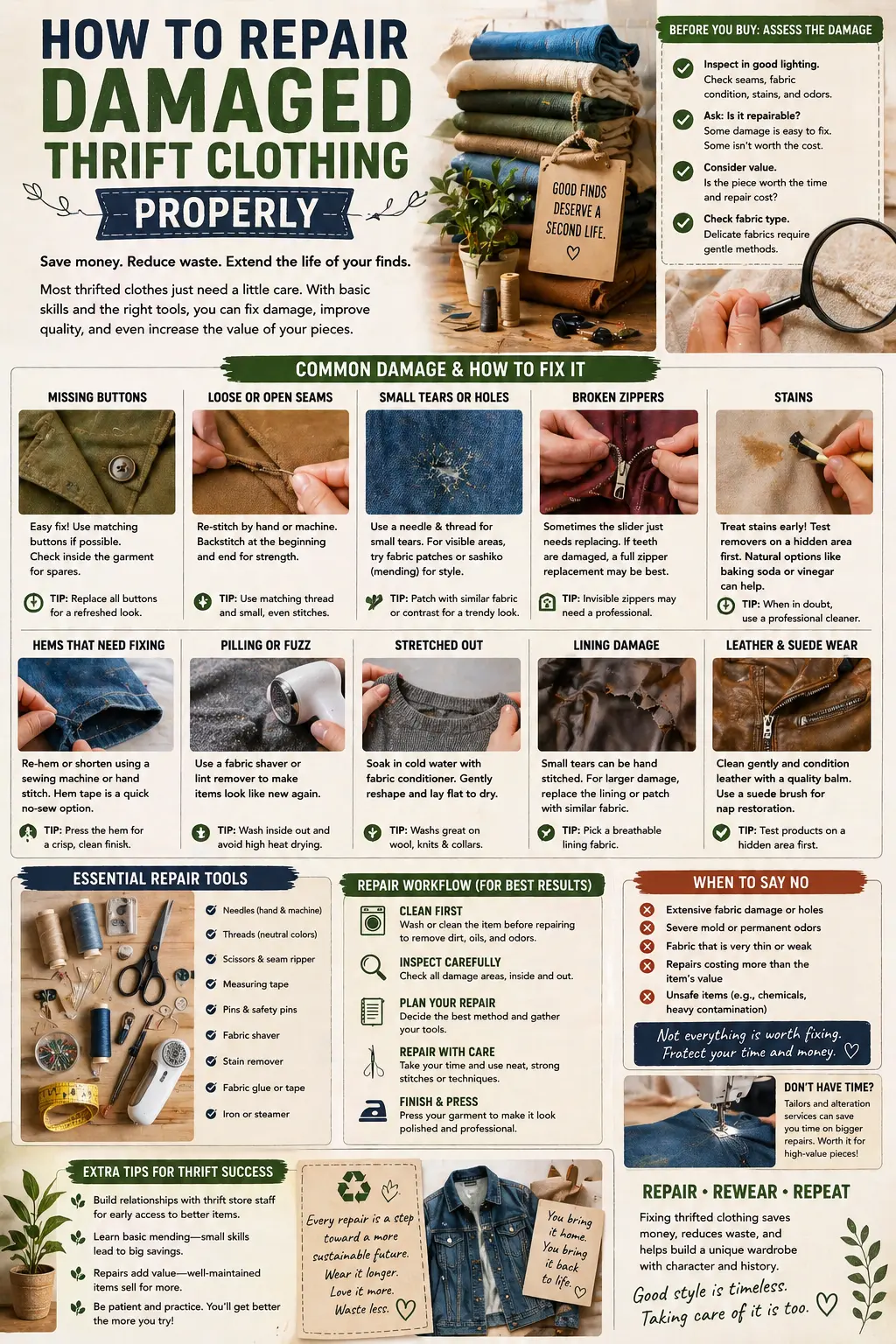
Thrift shopping has become far more sophisticated than simply hunting for cheap clothing. Across Canada, second-hand fashion has evolved into a growing ecosystem driven by sustainability, rising retail costs, vintage demand, and the increasing popularity of clothing resale businesses. Consumers are visiting thrift stores not only to save money but also to discover unique fashion pieces that feel different from mass-produced retail products. Entrepreneurs are building profitable resale businesses through platforms such as Depop, Poshmark, eBay, and Etsy by sourcing undervalued inventory and reselling it for profit. At the center of this growing market is one overlooked skill that separates casual thrift shoppers from serious buyers: the ability to properly repair damaged thrift clothing.
Many people walk into thrift stores and immediately reject garments with missing buttons, small tears, loose hems, broken zippers, fading, minor stains, or worn linings. They assume damaged clothing automatically represents wasted money. In many situations, that assumption is incorrect. Some of the most profitable thrift finds are pieces that other shoppers ignore because the flaws appear intimidating. A premium wool coat with a missing button may sell for a fraction of its normal value. A vintage denim jacket with minor seam damage may be overlooked despite strong resale potential. A high-end leather jacket with cosmetic wear may require simple restoration rather than full replacement.
This disconnect creates major opportunities for consumers who understand garment repair. Learning how to evaluate damage properly allows shoppers to identify hidden value where others only see problems. For personal shoppers, this means accessing higher-quality clothing at lower prices. For clothing resellers, repair skills can dramatically improve profit margins by allowing them to buy discounted inventory and restore it to market-ready condition.
However, not all damaged clothing should be repaired. One of the biggest mistakes beginners make is assuming every damaged item is worth saving. Some garments have structural issues that require expensive repairs exceeding resale value. Others may contain fabric damage that continues spreading over time. Successful thrift repair starts with understanding which garments deserve restoration and which ones should be left behind.
Learning How to Evaluate Damage Before Buying
The repair process begins before purchasing the item.
Many beginners become emotionally attached to a garment and ignore repair realities. They see a desirable brand name or attractive design and convince themselves that any damage can be fixed.
This mindset often leads to poor purchases.
Successful buyers inspect garments carefully under strong lighting. Small holes near seams may be simple fixes. Large tears in delicate fabrics may become expensive repairs. Missing buttons are usually minor problems. Major fabric thinning may signal deeper structural weakness.
Stretching, staining, odor damage, and material breakdown should also be evaluated carefully.
Understanding repair complexity prevents expensive mistakes.
Fixing Missing Buttons
Missing buttons are one of the easiest thrift repairs.
Many high-quality garments are heavily discounted because they are missing a single button.
If replacement buttons are included inside the garment, repairs become extremely simple.
If not, matching replacements can often be found online or at fabric stores.
For vintage items, replacing all buttons may create a cleaner appearance than trying to match one missing button.
This simple repair often creates strong resale opportunities.
Repairing Loose Hems
Loose hems frequently scare beginners because they assume sewing complexity.
In reality, basic hemming can often be completed with beginner-level sewing skills.
Dress pants, skirts, dresses, and shirts frequently require minor hem repairs.
Even fabric tape solutions may work temporarily for personal use.
Professional tailoring may be worthwhile for premium garments.
Repairing Small Tears
Small tears are often repairable when caught early.
Seam tears are usually easier because original stitch lines already exist.
Fabric tears require more caution.
Denim repairs can often be reinforced.
Patchwork repairs have become increasingly accepted in modern fashion.
Visible repair aesthetics are growing in popularity.
Removing Stains
Stains create major thrift opportunities because many shoppers avoid them immediately.
However, not all stains are permanent.
Oil stains, deodorant marks, makeup residue, and storage discoloration may be removable.
Professional cleaning may help.
Always test products carefully.
Some stains remain permanent.
Fixing Broken Zippers
Broken zippers frequently discourage buyers because they seem expensive.
In many cases, zipper sliders simply need replacement.
Full zipper replacement may require professional help.
For premium jackets, this investment may be worthwhile.
Restoring Leather Items
Leather jackets and bags often show wear.
Conditioning products can restore appearance.
Minor scratches may improve significantly.
Deep cracking may be harder to fix.
Quality leather often ages beautifully.
Repairing Linings
Damaged linings are common in coats and formalwear.
Small tears may be simple repairs.
Full lining replacements require higher costs.
Evaluate carefully.
Dealing With Fading
Color fading does not always ruin garments.
Black clothing can often be re-dyed.
Denim fading may actually increase value.
Understand market preferences.
Cleaning Odor Issues
Smoke odors, storage smells, and mildew create major challenges.
Professional cleaning may solve issues.
Severe mildew may be too risky.
When Repairs Are Not Worth It
Some garments should be avoided.
Major structural damage
Severe fabric weakness
Permanent odors
Extensive mold
These problems often exceed value.
Repair Tools Worth Owning
Basic sewing kits
Fabric shavers
Steamers
Stain removers
These tools create long-term savings.
Repairing for Resale
Buyers expect honesty.
Always disclose repairs.
Quality repairs improve margins.
Poor repairs hurt reputation.
Sustainability Benefits
Repairing clothing reduces waste.
It extends product lifespan.
It supports circular fashion across Canada.
Final Thoughts
Repairing damaged thrift clothing properly can transform average shoppers into highly strategic buyers.
The people who profit most from thrift shopping are often not the ones who find perfect clothing—they are the ones who recognize repairable value before everyone else notices it.
